
Build Better, Cheaper LLM Agents with Hill Climbing
- Published on
- Authors

- Name
- Arthur Reimus
- @artreimus
Key Takeaways
- Turn failed traces into small, testable edits. Each accepted edit becomes the starting point for the next round.
- Tune decision quality and cost per ticket on the same eval, then check the winner on fresh cases.
- Keep the eval and best configuration so the next model upgrade starts from a measured baseline.
Hill climbing can improve agent quality and cut costs in the same tuning run. In Anthropic’s support benchmark, decision accuracy rose from 78.6% to 90.5% on 14 held-out tickets at about one fifth of the baseline token cost. Support benchmark
An eval makes that kind of tuning repeatable. An editor reads a failed trace and proposes one change. Run the candidate and the current best on the same cases. The next round starts from the version that scored best within your limits. That gives teams a way to improve the prompts, tools, and settings around an LLM between model releases.
In our support demo, a customer asks for a refund 42 days after buying. The policy sends requests after day 30 to manual review. The baseline router approves it anyway. A fix has to catch that ticket and still approve refunds on day 30.
Use our Python demo to compare two versions of the router. To run the full loop with your own agent, load the skill folders in your client or give a coding agent their SKILL.md files. Agent Optimization Skills and runnable demo
Trace a repeated call back to the prompt
Imagine the LLM version calls lookup_order twice for the same refund. Give prompt-audit the trace, tool description, and support prompt. Compare the arguments and results of both calls. If both fetch the same order state and the prompt says to check it twice, you have a specific edit to try.
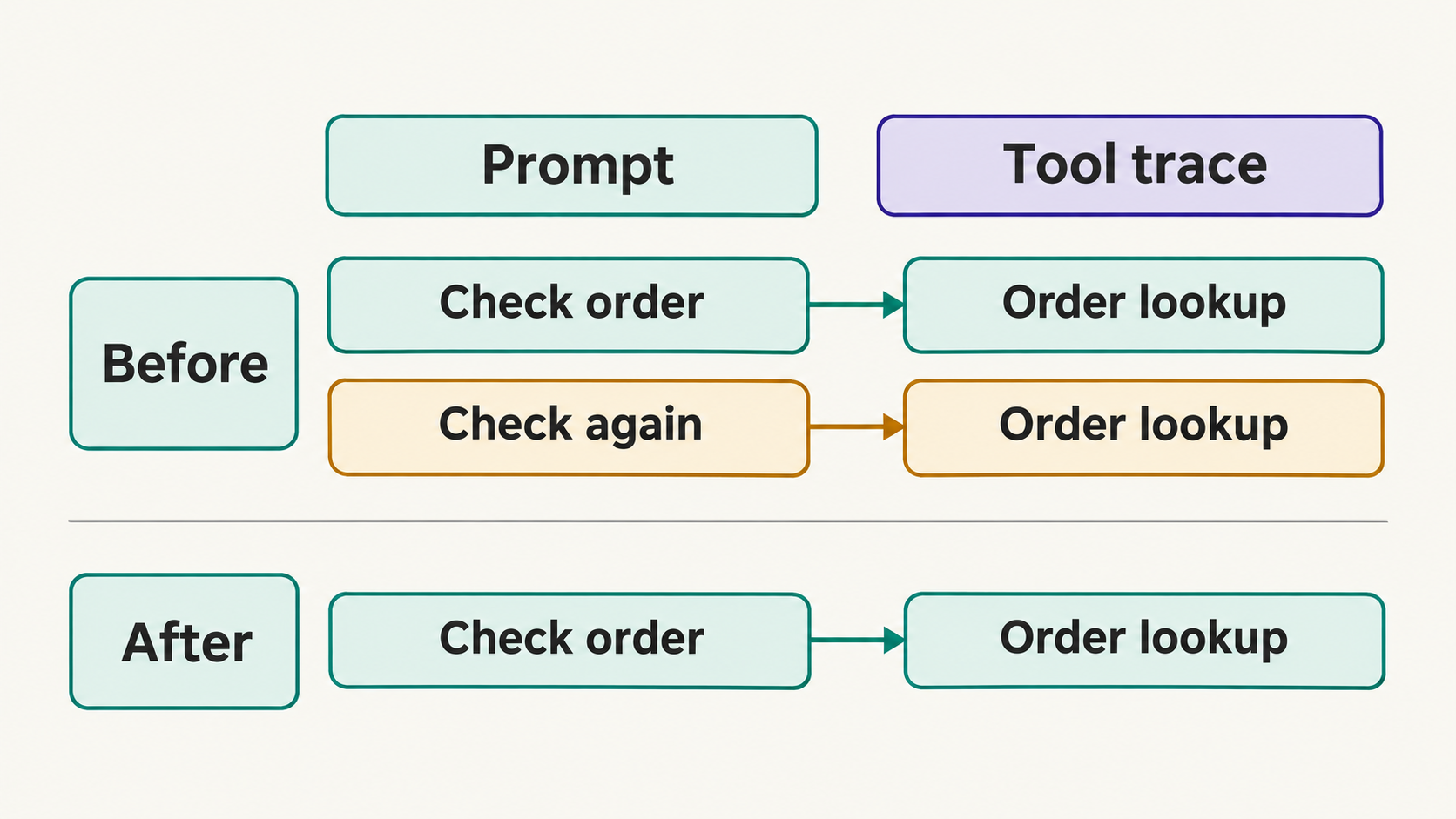
An illustrative trace. Removing the repeated instruction can save a tool call on each affected ticket.
Remove the repeated check and replay the ticket with the same model and tools. Look for one call to fetch the order and the same eligibility decision. Try a day 30 refund too. The call count tells you whether the edit saves work. The decision tells you whether it preserved policy.
Check the prompt cache on repeated turns
A prompt prefix is the sequence of tokens at the start of a request. An eligible first request can cache the work of processing that prefix. Later requests can reuse it if the prefix still matches and the cache entry is available. Put stable tool definitions and refund policy first. Append ticket data and timestamps, and set a breakpoint after the stable prefix if your API requires one.
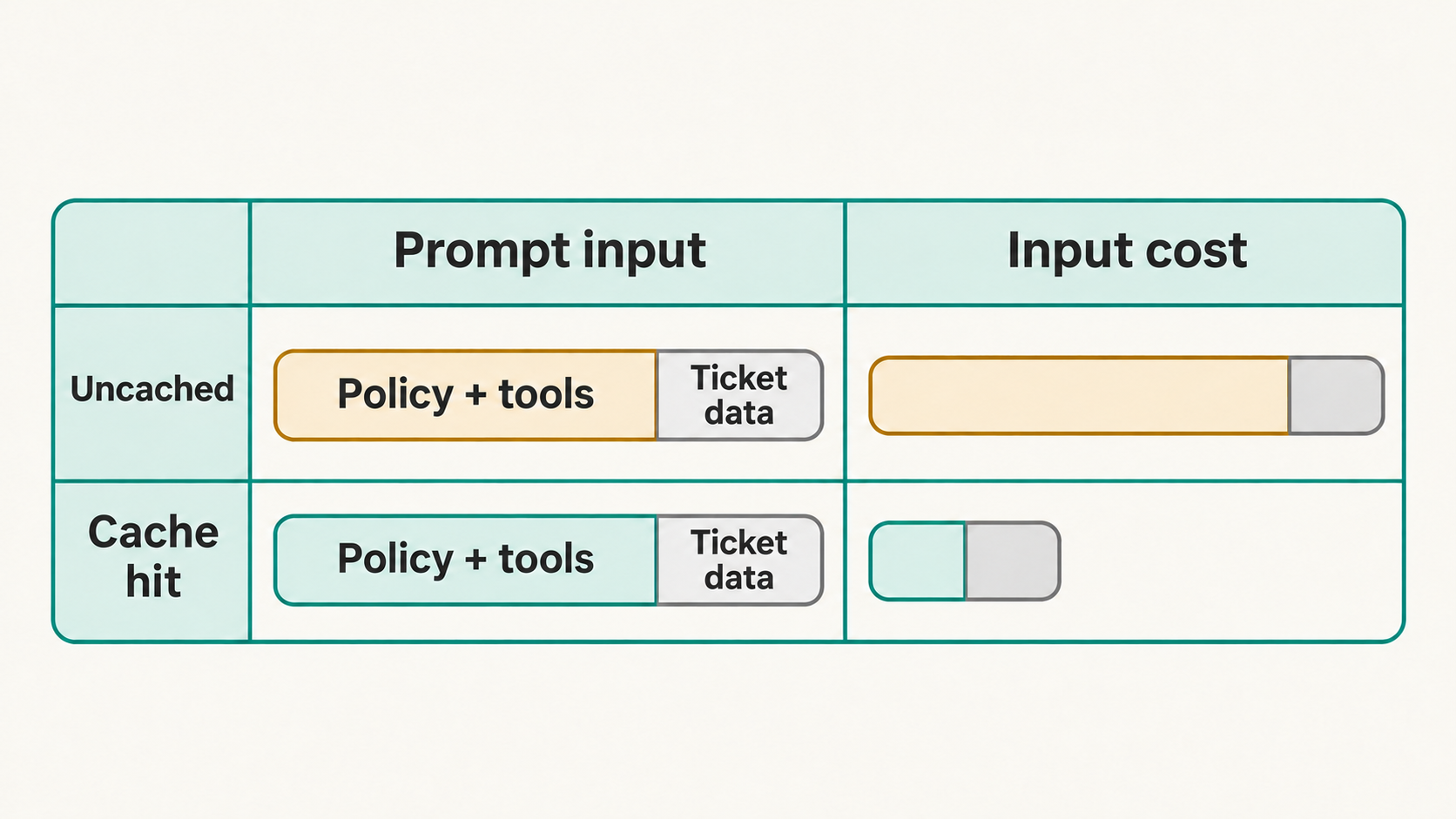
Schematic input charges on a provider that discounts cache reads. The prompt stays the same length. The new ticket still bills at the regular input rate.
For example, suppose 8,000 tokens are reusable policy and tools and 2,000 are new ticket data. At one tenth of the regular price for cache reads, a hit costs the equivalent of 800 regular tokens for the prefix plus 2,000 for the ticket. Compared with processing all 10,000 tokens at the regular rate, that’s 72% less input cost on the hit. Give cost-optimize the request code and usage logs. Compare billed cost per ticket across the same workload, including cache writes and misses.
Build an eval with room to improve
Give build-eval approved support traces and the refund policy. Include refunds on days 29, 30, and 31, plus login and billing tickets to catch routing regressions. Give each case an ID, the ticket input, and an expected action. Replay order lookups and use a simulated refund tool that records the decision. The grader compares that record with its answer key, which stays outside the agent’s inputs.
Run the current agent several times with the same settings to see how much its score varies. Probe with a stronger model or higher effort to see whether the eval can register better decisions. If nearly every case passes, add harder cases that still resemble real tickets. If a case looks correct but fails, inspect its expected action and grader before changing the prompt.
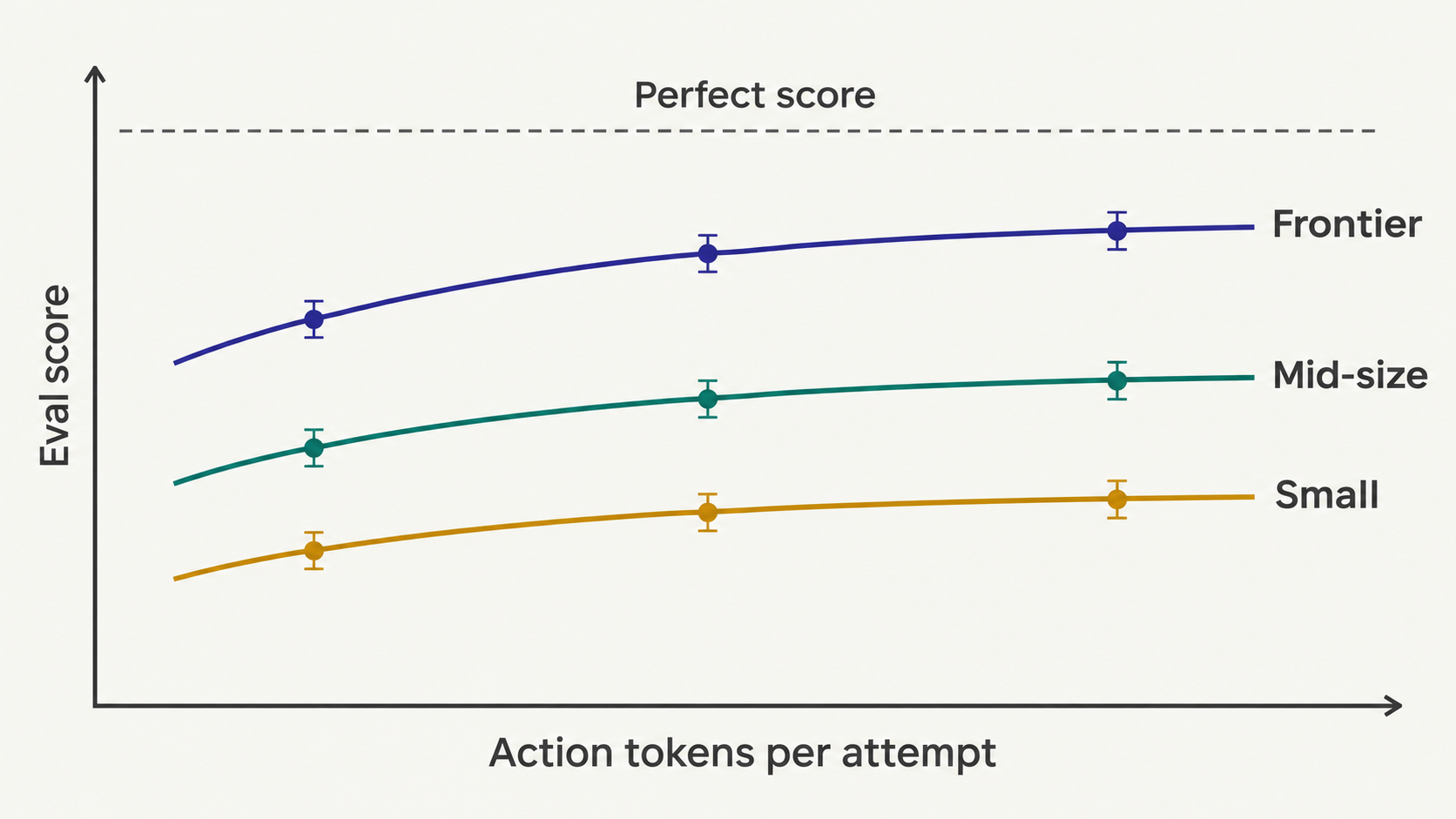
Illustrative scores at different token budgets. A useful eval leaves room to improve.
Hill climb on training failures
If every late refund in training is 42 days old, the editor can hardcode that age and miss the cutoff. Vary the dates and wording, and keep versions of the same ticket together when splitting cases.
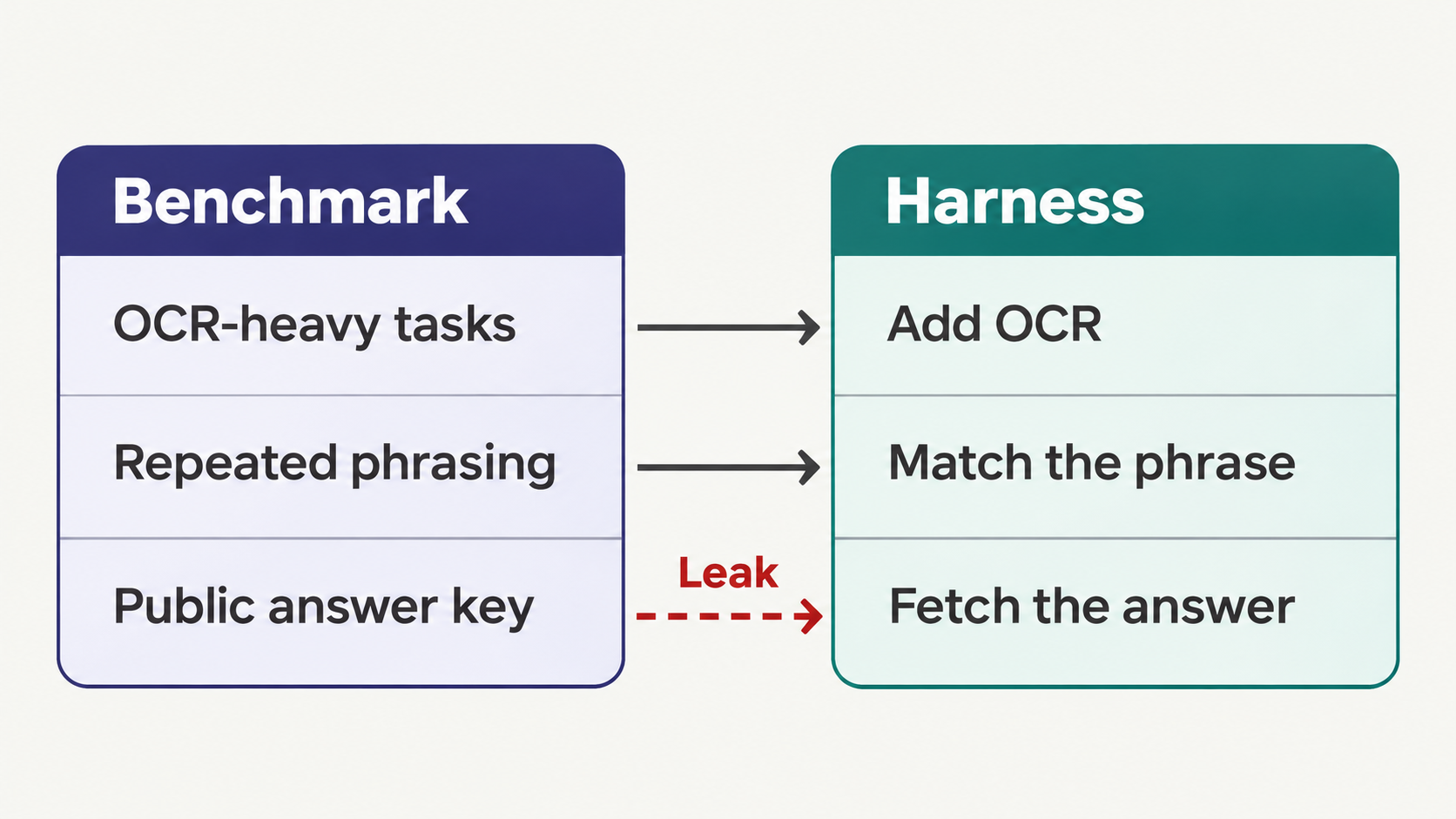
Repeated patterns reward shortcuts. The dashed path shows what happens when the answers leak.
Give hill-climb the eval command and a narrow brief.
Edit the support prompt to improve decision accuracy. Keep the refund policy intact. Stop after five rounds.
Let the editor inspect training traces and propose one change per round. Compare each candidate with the current best using the same cases, repeats, and grader. Give the editor aggregate validation scores and keep the validation traces separate. When a candidate wins, build the next edit on top of it. A change that sends every refund to review may fix the day 42 failure, but it fails the tickets inside the policy window.
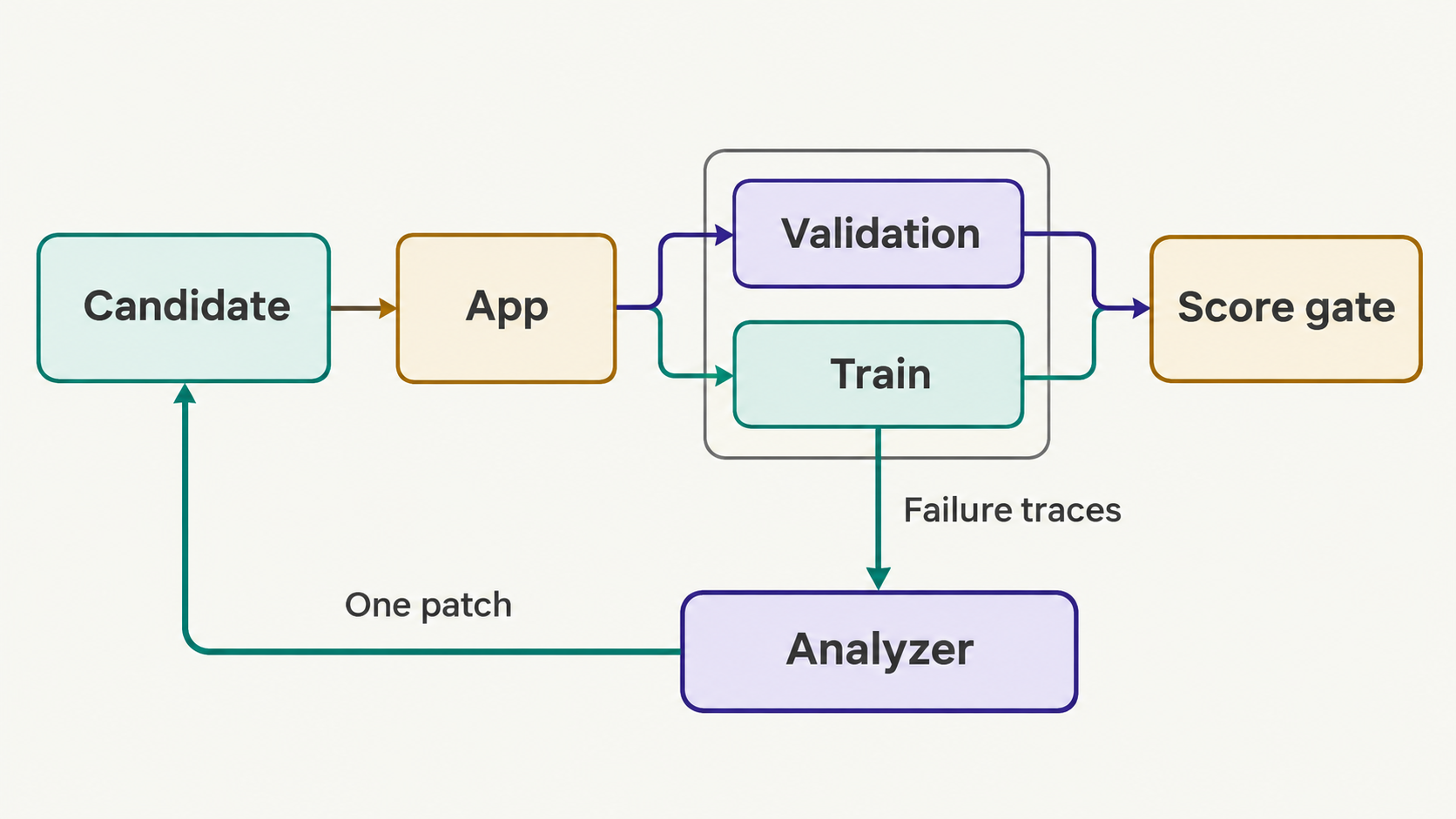
Adding the cutoff rule takes the deterministic demo from three to four correct decisions on both validation and test, with four tickets per split. In a live agent eval, keep validation gains that clear normal run variation. Set aside an untouched test set before tuning and use it at the end to compare the original baseline with the winner. With too few cases to split, treat gains as exploratory.
Use the same loop to improve a skill
If your agent loads refund guidance from a skill, you can tune that file with the same ticket eval. Give hill-climb the runner and limit edits to the skill’s SKILL.md. Hold the model and tools fixed so the comparison tells you what the skill change did.
If scores stall, read a few failures before expanding the instructions. In Anthropic’s claude-api skill eval, one task asked for one error type and the grader required at least three. A prompt edit could have taught the agent to satisfy the grader at the expense of the task. After a grader repair, rescore saved outputs from both versions. If the task changes, rerun both versions on the revised inputs. API skill experiment
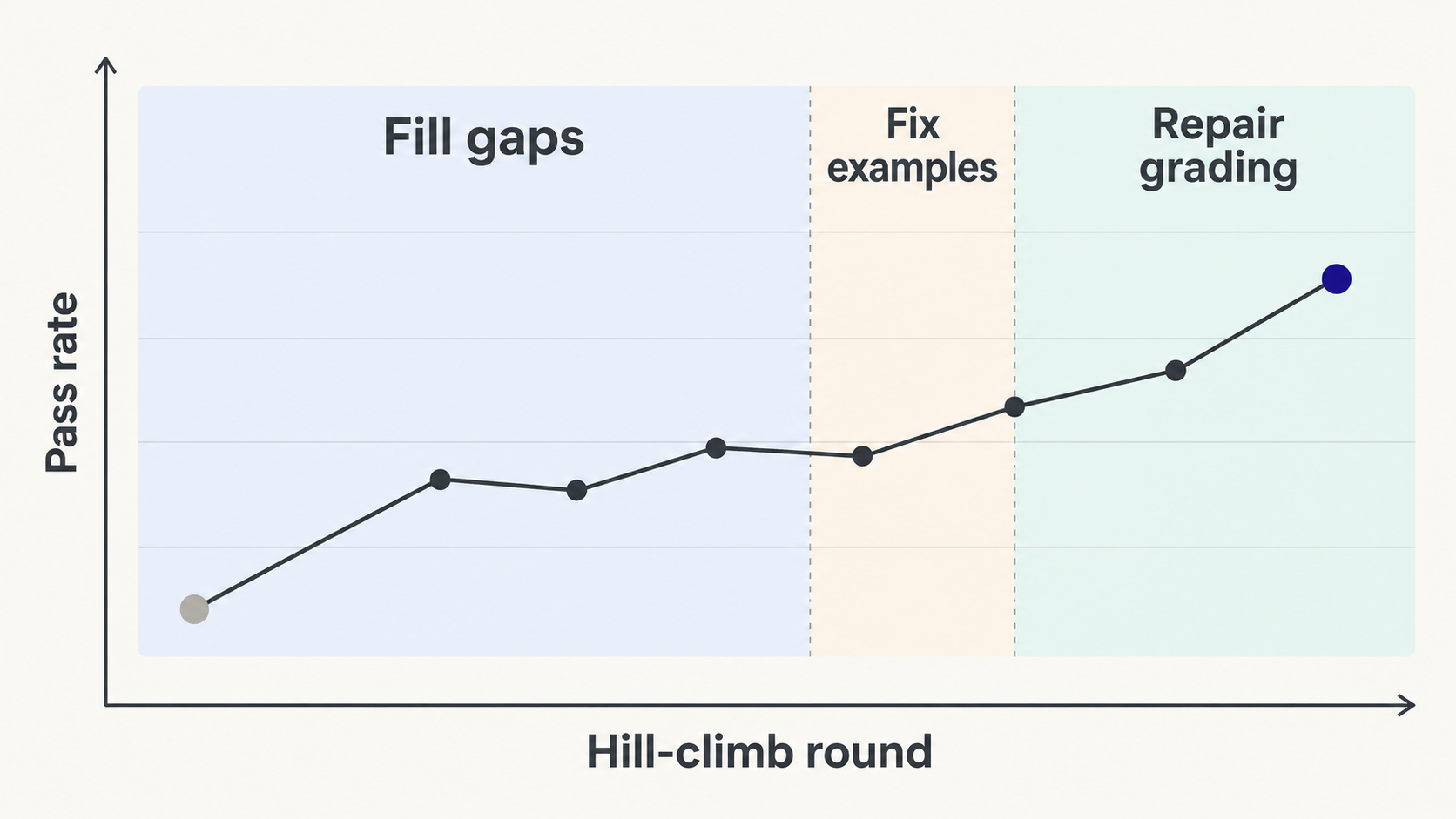
Anthropic reported a climb from 66.1% to 87.9% by round 24. The final score includes task and grader repairs alongside skill edits.
Cut token cost while protecting accuracy
Once the agent routes tickets reliably, switch the objective to cost per ticket. Set a floor at baseline accuracy and require late refunds to reach review. A cheap model that handles login tickets well can still fail that policy check. Test model, effort, and prompt changes one at a time on the same eval. Count all model requests for the ticket, including retries and cache charges.
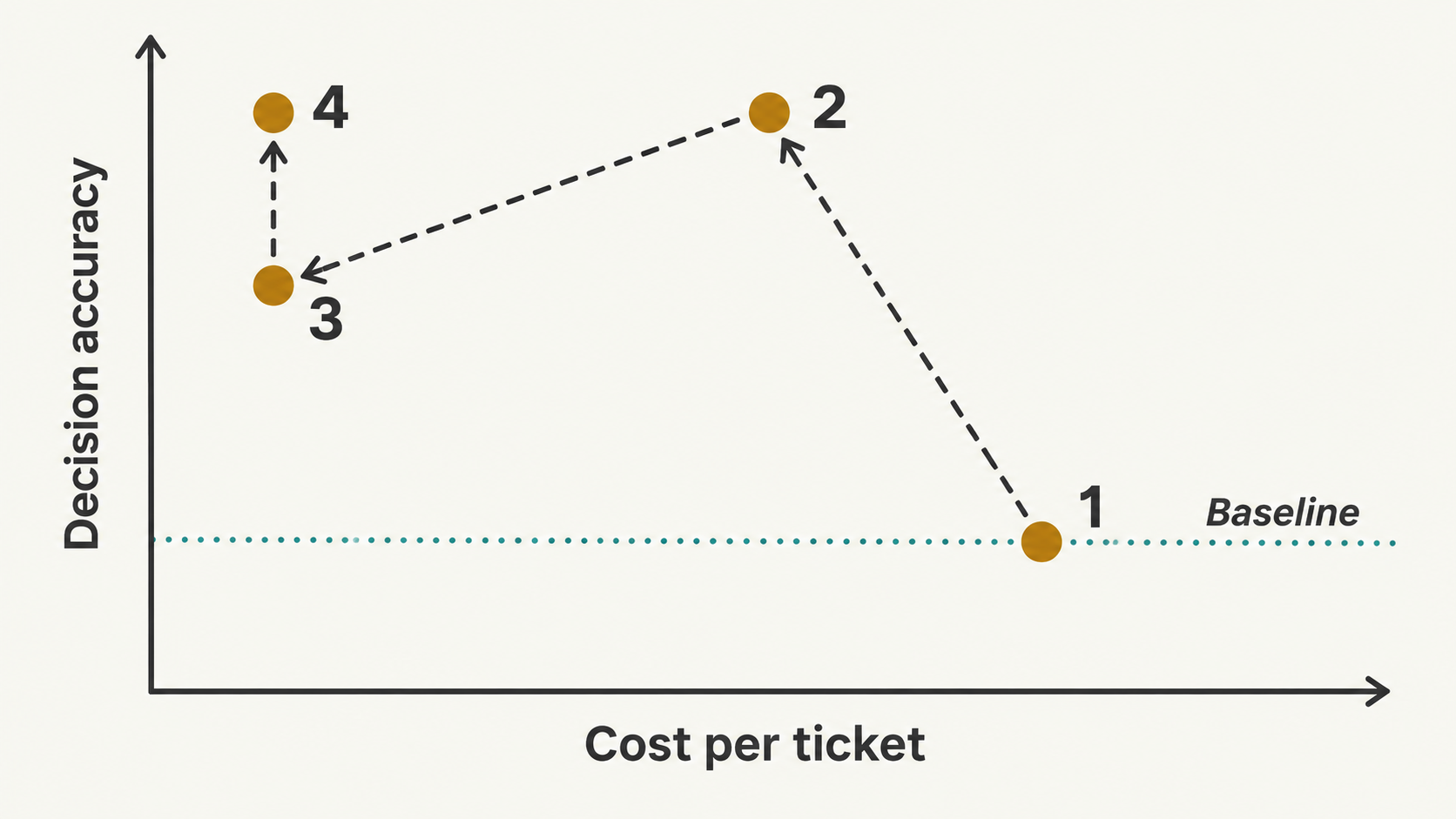
Four training checkpoints on the Opus 5 path from Anthropic’s support benchmark. Left is cheaper. Up is more accurate.
| Step | Configuration | Training decision accuracy | Token cost per ticket |
|---|---|---|---|
| 1 | Opus 4.8, high effort | 74.4% | 4.6¢ |
| 2 | Opus 5, low effort, audited prompt | 98.9% | 2.6¢ |
| 3 | Sonnet 5, low effort | 88.9% | 1¢ |
| 4 | Sonnet 5, low effort, revised routing and refund rules | 98.9% | About 1¢ |
Step 2 bundles three changes. Steps 3 and 4 hold the model and effort fixed. A prompt revision gained 10 percentage points on the training cases while token cost stayed around 1¢ per ticket. The result at the top of the post comes from the separate set of 14 tickets held out from tuning. Baseline in the eval playbook · Opus 5 cost path
Make longer runs recoverable
After each round, record the candidate, model settings, eval version, score, and keep or reject decision. Save the best revision and remaining budget outside the runner’s scratch space. If a run stops midway, you can resume from the last completed round and know which comparison still needs to run.
Keep the eval and the best measured configuration together. Save the refund review steps in refund-review/SKILL.md. When a new model arrives, run it and the current best on the same versioned eval. You can see whether the upgrade earns its cost and start the next climb from whichever setup performs best.
References
- Lance Martin, “Your Old Prompts Are Making Claude Worse”, AI Engineer. Reference for the five diagrams from eval design through the cost experiment.
- Anthropic, “Automating eval design and hillclimbing with Claude”.
- Anthropic, “Reducing cost and improving performance with Claude Platform”.
- Anthropic, “Prompt caching”, Claude Platform Docs.
- OpenAI, “Prompt caching”, API Docs.
- Anthropic, “Claude API eval skill guides”.
- Ylang Labs, Agent Optimization Skills, with the support routing demo.